

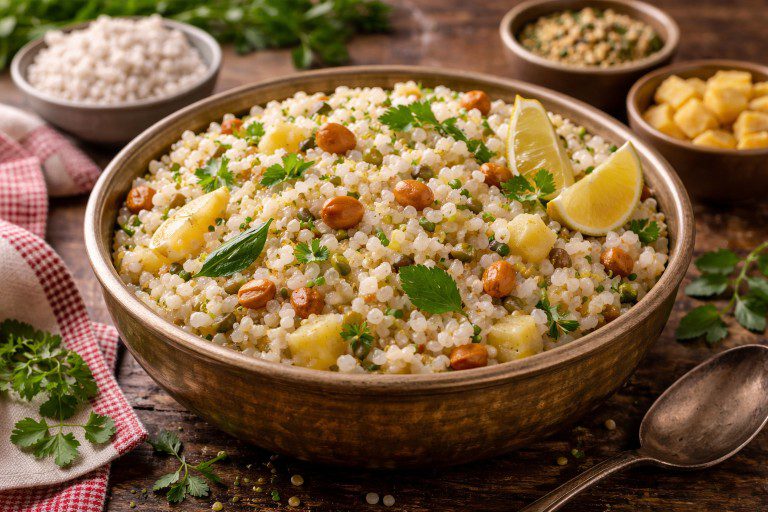
A Simple and Flavorful Recipe
Sabudana khichdi holds a special place in our home because it is the one dish both Harish and I crave during Navratri fasting. I learned to make it from a Maharashtrian colleague in Mumbai who insisted that the secret is soaking the sabudana overnight and making sure every pearl is dry and separated before it hits the pan. My first attempt was a sticky, clumpy disaster because I had not drained the pearls properly. The version I make now comes out perfectly — each pearl is translucent and separate, the peanuts are crunchy, and a squeeze of lemon at the end brings everything together. It has become our go-to fasting meal, but honestly, we make it just as often on regular mornings when we want something light and satisfying.
Sabudana khichdi is a light, savoury dish made with tapioca pearls, roasted peanuts, and gentle spices. It is one of the most popular fasting foods in India, especially during Navratri and Ekadashi, but it works just as well as an everyday breakfast or a quick afternoon meal. The soft, chewy texture of the sabudana paired with the crunch of peanuts creates a contrast that makes every bite interesting.
What makes this dish so loved is how comforting it feels while being genuinely easy on the stomach. It is naturally gluten-free, rich in carbohydrates and healthy fats, and provides steady energy without heaviness. A drizzle of ghee, a handful of roasted peanuts, and a squeeze of fresh lemon juice are all it takes to turn these simple pearls into something truly delicious.
Origin of Sabudana Khichdi
Sabudana, or the tapioca pearl, is taken from cassava roots. In the 17th century, the Portuguese brought it to India, and it has been a staple of Maharashtrian cuisine. Indians have learned to incorporate it into their tradition, using sabudana as an ingredient for fasting recipes over time.
Sabudana khichdi is said to have originated in Maharashtra and is a food item. The food is mainly taken during the fasts like Navratri and Ekadashi. Being a carbohydrate product, it surely provides a good amount of energy during the fasting time. Now, it is enjoyed throughout India either as a breakfast or a snack.
Why Sabudana Khichdi is Important in Indian Cuisine
Sabudana khichdi holds a special place in Indian cuisine because of its cultural and nutritional significance:
It is a "vrat-friendly" dish; therefore, it meets the diet requirement of fasting as it excludes onion, garlic, and grains. Vrat means pious observances such as fasting and pilgrimage (Tirtha) found in Indian religions.
Nutritional value: It is a fast source of carbohydrates, which is a huge advantage while fasting or when it comes to an early morning meal.
Versatility: This sabudana khichdi can be easily adapted according to regional tastes or preferences with simple ingredients.
It portrays the ingenuity of Indian Cuisine, creating taste from limited ingredients.
Cooking Time to prepare Sabudana Khichdi:
Prep time: 4 hours (allowing sabudana to absorb)
Cook Time: 20 mins
Ingredients for the khichdi:
Sabudana (Tapioca Pearls) -1 cup
A main ingredient responsible for the doughy, gooey texture of the dish
- Peanuts - 1/2 cup (roast and coarsely grind).
- Adds nuttiness and crispness
- Potatoes -1 medium (take out seeds) boil and shred
- Adds depth to the entire dish
- Chilly Green - 2
- Chop them well
- Add a bit of spice, not too heavy.
- Curry Leaves - 6-8
- Add aroma
- Cumin Seeds - 1 tsp
- This adds an earthy flavour
- Ghee or Oil - 2 tbsp
- For cooking it and flavouring it
- Lemon Juice - 1 tbsp
- Add a tinge of zing
- Sendha Namak - To Taste
- Rock Salt used to make food on fasting days.
- Coriander Leaves - 2 tbsp, chopped
- Use it for garnish.
Process for making Sabudana Khichdi at home:
Soaking the Sabudana
- Wash the sabudana pearls under running water 2-3 times to remove excess starch
- Soak sabudana in water that is just sufficient to cover the pearls for 4-6 hours or overnight
- The sabudana pearls would have become soft and non-sticky after soaking, and excess water must be drained off
Preparation of the Peanuts:
- Roast the peanuts in a dry pan on low heat and let them cool
- Crush them to a coarse powder and keep them separately
Cook the Khichdi:
- Heat ghee or oil in a pan. Add cumin seeds and let them splutter.
- Add curry leaves and green chillies. Sauté for a few seconds.
- Stir in boiled, diced potatoes and cook for 2 minutes.
- Add the soaked sabudana and mix well. The heat should be medium-low so it doesn't stick.
- Sprinkle the ground peanuts and salt. Mix lightly.
- Cook for 5-7 minutes, stirring occasionally, till sabudana turns translucent.
Finishing Touches
- Add lemon juice and mix well.
- Garnish with chopped coriander leaves and serve hot.
Nutritional Value (Per Serving)
Calories: 320 kcal | Protein: 5 g | Carbohydrates: 50 g | Fat: 12 g | Fiber: 3 g
Serving Suggestions:
Sabudana khichdi tastes the best when served lukewarm in a bowl or even a chilled glass of buttermilk, besides a bowlful of curd. It goes rather well with these sweet dishes. Add fruit salad on the sides to make a complete meal.
Tips towards making perfect, no-sticking sabudana khichdi
- No sticks sabudana: Always keep the sabudana covered with just enough fresh water to fully submerge it.
- Do Not Overcook: Cook over a low flame in order not to make the sabudana too sticky or mushy.
- Adding Texture: Whole roasted peanuts would add crunch when sprinkled at the end
- Customisation: Add a little red chilli powder for the spicier flavour if not on a fast.
Sabudana khichdi, a dish beyond just a creation, signifies the genius of Indian food in such a way that simplicity, along with versatility, is infused. Be it fasting or when you need some wholesome food to eat, there is nothing to lose here-it is the ideal dish for everything. Recreate this timeless recipe at your place and relish the nice flavours from Indian tradition!
Share your thoughts on our Instagram Channel @thefood.travellers