

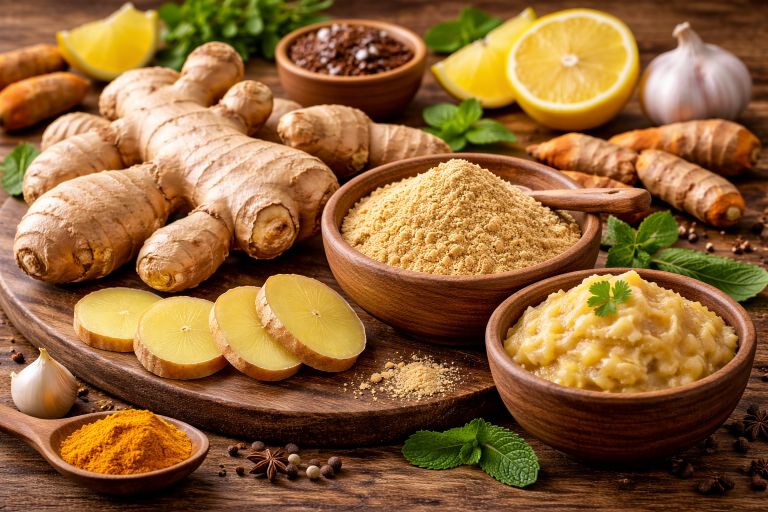
Know Your Ingredient: Ginger – The Fiery Root with Countless Benefits
Ginger is one of those ingredients I reach for almost instinctively — it goes into my chai every morning, into most curries, into soups when someone has a cold, and even into a few desserts. My mother always kept a piece of fresh ginger in the kitchen and would grate it into warm water with honey whenever any of us had a sore throat. It worked every time, or at least it felt like it did. When I started cooking on my own, I realised how much flavour fresh ginger adds compared to the dried powder — there is a sharpness and warmth in fresh ginger that lifts everything it touches. This post is my deep dive into an ingredient I use daily but never fully appreciated until I started reading about its history, health benefits, and the remarkable journey it has taken across cultures and continents.
Ginger, scientifically known as Zingiber officinale, is one of the most treasured ingredients in the world. This humble rhizome carries a history that stretches across continents and cultures, valued equally in kitchens and in traditional medicine for thousands of years. Its warm, sharp flavour and proven health benefits have kept it relevant through every era of cooking and healing.
From ancient Ayurvedic remedies to modern kitchens, ginger continues to impress with its versatility. It works as a spice, a medicine, a tea ingredient, and a flavour enhancer all at once. In this post, I explore the fascinating journey of ginger — from its origins in Southeast Asia to its place as a global culinary and medicinal staple.
Origin of Ginger
The story of ginger, known as Adrak in Hindi, begins in the lush tropical forests of Southeast Asia. Because the region offered warm temperatures and fertile soil, ginger plants thrived easily there.
Early civilisations in China, India, and Indonesia quickly discovered the plant’s remarkable culinary and medicinal properties. As a result, ginger soon gained recognition as both a valuable spice and a powerful herbal remedy. In fact, ancient Indian and Chinese texts written thousands of years ago describe ginger as a prized ingredient.
The Botanical Tale
Ginger grows naturally in the tropical rainforests of Asia, particularly in China, India, and Indonesia. The plant flourishes in hot and humid climates, where it develops thick underground stems called rhizomes.
These rhizomes form the knobby, aromatic root that people use in cooking and medicine. Furthermore, the plant produces long green leaves and delicate yellow flowers above the soil. However, the rhizome remains the most valuable part of the plant.
A History of Significance
Ginger holds deep historical significance because of its role in culture, trade, and traditional medicine. Early Chinese medical records from the 4th century BCE already praised ginger for its healing properties.
Meanwhile, Chinese sailors transported ginger to different regions through maritime trade routes. Consequently, the root began appearing in many civilisations beyond East Asia.
At the same time, India embraced ginger as an essential component of Ayurvedic medicine. Ayurvedic practitioners valued ginger for its digestive, anti-inflammatory, and respiratory benefits. Therefore, many ancient texts referred to it as a “wonder root.”
Ginger on the Silk Road
As international trade expanded, ginger travelled even further across the world. The Silk Road connected Eastern and Western civilisations, allowing spices and herbs to circulate widely.
Arab traders introduced ginger to the Mediterranean region, where it quickly became popular in both cooking and medicine. From there, merchants carried it to Persia and eventually to Europe. Consequently, ginger began influencing culinary traditions far beyond Asia.
Ginger in Medieval Europe
During the medieval period, ginger became one of the most valuable spices in Europe. Because importing spices required long and expensive trade routes, only wealthy families could afford them.
As a result, ginger symbolised status and luxury. Noble households often used the spice in festive dishes and elaborate desserts. Moreover, European cooks began experimenting with ginger in baked goods, sauces, and drinks.
The Age of Exploration
Later, the Age of Exploration transformed the spice trade once again. Explorers such as Marco Polo and Christopher Columbus helped expand global trade routes. Consequently, ginger became more widely available in Europe and other parts of the world.
As accessibility increased, the spice gradually moved from royal kitchens to everyday households. Therefore, ginger began appearing in a wide variety of regional cuisines.
Ginger: A Culinary Superstar
With growing popularity, ginger quickly established itself as a versatile culinary ingredient. Its warm, slightly spicy flavour complements both sweet and savoury dishes.
For instance, English cuisine uses ginger in gingerbread, while Indian cooking incorporates it into curries, chutneys, and masalas. Meanwhile, Asian cuisines frequently use fresh ginger in stir-fries, soups, and marinades.
Because of its distinctive taste and aroma, ginger continues to enhance dishes across the globe.
Ginger’s Health Benefits
Anti-Inflammatory Powerhouse
Ginger contains powerful bioactive compounds such as gingerol, which help reduce inflammation. Therefore, many people use ginger to relieve arthritis symptoms and muscle soreness.
A Stomach Soother
For centuries, people have relied on ginger to calm digestive discomfort. It helps reduce nausea caused by motion sickness, pregnancy, or medical treatments. In addition, ginger stimulates digestive enzymes and helps balance stomach acidity.
Immune Booster
Ginger contains antioxidants that help strengthen the immune system. Consequently, it protects the body from oxidative stress and harmful free radicals.
Natural Pain Reliever
Ginger also acts as a natural pain reliever. Many studies show that it can reduce headaches, menstrual cramps, and muscle pain.
Heart Health
Ginger supports cardiovascular health in several ways. It helps improve blood circulation while lowering blood pressure and cholesterol levels. As a result, it may contribute to overall heart health.
Potential Anti-Cancer Properties
Researchers have also studied ginger’s potential role in cancer prevention. Certain compounds, including gingerol, may slow the growth of malignant cells. However, scientists still require more evidence before confirming these benefits.
Blood Sugar Regulation
Ginger may help regulate blood sugar levels. Because it improves insulin sensitivity and glucose metabolism, it can support people with diabetes or those at risk. Interestingly, black ginger has also shown potential in supporting blood sugar control.
Natural Antibacterial Agent
Ginger also contains antimicrobial compounds that fight harmful bacteria. Consequently, it helps the body combat infections while strengthening immunity.
Conclusion
From its humble origins in tropical Asia to its global popularity today, ginger has travelled an extraordinary journey. Over time, this powerful root has transformed from a regional herbal remedy into a worldwide culinary staple.
Today, people continue to enjoy ginger not only for its unique flavour but also for its impressive health benefits. Therefore, whether you use it in teas, curries, desserts, or home remedies, ginger remains a truly remarkable ingredient.
Have you tried cooking with ginger?
Share your experiences by tagging us on Instagram @thefood.travellers with the hashtag #ginger.
Comments are closed.