

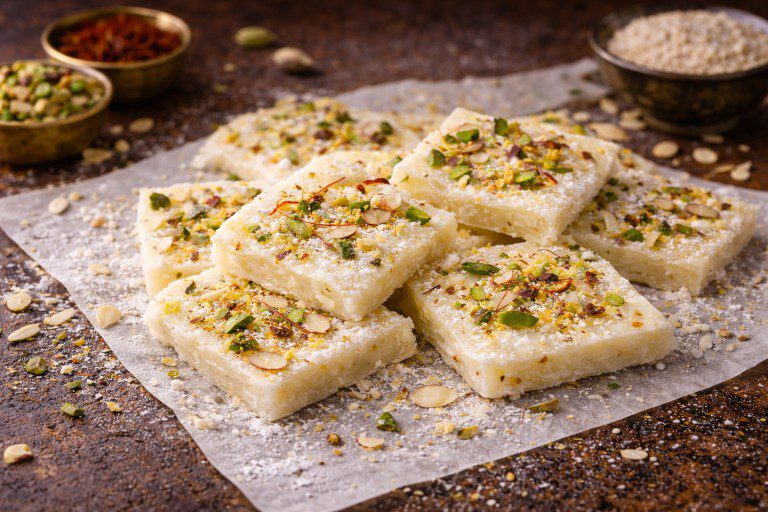
Ice halwa is one of my favourite childhood memories from growing up in Mumbai. Every Diwali, boxes of these paper-thin, saffron-dusted sheets would appear at home, and I would carefully peel each layer apart before letting it dissolve on my tongue. It was the one sweet I looked forward to more than any other, and even now, the smell of ghee and saffron together takes me straight back to those celebrations. When I decided to try making it at home in Bangalore, I honestly did not think I could get the sheets thin enough. It took me three attempts before I figured out the right temperature and spreading technique, and this recipe is what finally worked.
What Is Ice Halwa?
Ice halwa is a paper-thin Indian sweet made from milk, sugar, ghee, and cornflour. It is layered with powdered sugar and topped with pistachios, almonds, and fragrant saffron. What makes it truly special is the texture — it is glossy and almost translucent, melts instantly in the mouth, and finishes with a subtle chew and nutty crunch that lingers. Despite its name, ice halwa is not frozen. It gets the name "ice" from its cool, soothing mouthfeel that feels unlike any other Indian sweet.
The Accidental Invention of Ice Halwa
Ice halwa is believed to have originated in early 20th-century Mumbai, widely credited to Ratanlal Chunilal Halwai, founder of the legendary Mohanlal S Mithaiwala, also known as Bombay Halwa House. The story goes that one day, while preparing traditional Bombay halwa, the halwai accidentally spread the hot mixture too thin over a greased surface. Instead of forming a thick, chewy halwa, it cooled into a delicate sheet. Curious, he dusted it with powdered sugar, added nuts, and stacked the sheets between parchment paper. The first bite revealed a texture Mumbai had never tasted before, and what started as a mistake quickly became a masterpiece.
Although there is no exact documented date, culinary historians trace its invention to the 1920s or 1930s, a period when artisan halwai innovation was flourishing across Bombay. Mumbai was a thriving trade hub at the time, which gave halwais access to premium ghee, fine sugar, and high-quality nuts. That access to good ingredients helped ice halwa develop a reputation for luxury and finesse early on.
When Was Ice Halwa First Made?
Although there is no exact documented date, culinary historians trace its invention to the 1920s–1930s. During this period, artisan halwai innovation flourished across Bombay.
Because Mumbai was a thriving trade hub, experimentation in sweets became common. As a result, Ice Halwa quickly gained popularity and soon became a premium travel sweet across India.
Cultural Roots of Ice Halwa
Ice halwa evolved from the cornflour-based Bombay halwa tradition, but refined the texture into something thinner and far more elegant. Most of the early halwais in Mumbai were Gujarati artisans, and their emphasis on precision and texture control shaped what ice halwa became. Mumbai's position as a port city also played a role — the easy availability of premium ingredients meant halwais could experiment freely, and ice halwa was one of the finest results of that experimentation.
Why Ice Halwa Became a Bombay Icon
There are a few reasons ice halwa earned its place alongside vada pav, pav bhaji, and cutting chai as a true Bombay classic. The texture is unlike any other Indian sweet — light, silky, and almost weightless. It has a long shelf life of fifteen to twenty days when stored properly, which made it ideal for gifting and travel. The flavour is rich yet delicate, with saffron, nuts, and ghee creating a premium taste without being overwhelmingly sweet. Over the years, it has also expanded into flavours like kesar, rose, chocolate, mango, and coconut, which keeps it feeling fresh and modern. And then there is the visual appeal — pastel-coloured sheets sprinkled with saffron strands and crushed nuts make it almost too beautiful to eat.Traditional Kesar Ice Halwa Recipe
Although Ice Halwa may look delicate, it is surprisingly simple to prepare — provided you follow each step carefully.
Time Required
- Prep Time: 10 minutes
- Cooking Time: 20 minutes
- Cooling Time: 1–2 hours
- Total Time: ~1.5 hours
Ingredients (20–25 Sheets)
Halwa Base
- 1 cup milk
- 1 cup sugar
- 1 cup fresh cornflour
- ¼ cup ghee
- 1 pinch saffron soaked in warm milk
- ½ tsp cardamom powder
- A few drops of rose water (optional)
Toppings
- 2–3 tbsp powdered sugar
- 2 tbsp chopped pistachios
- 2 tbsp chopped almonds
- 1 tsp saffron strands
Step-by-Step Method
1. Prepare the Base
First, combine milk, sugar, cornflour, and ghee in a heavy-bottom pan. Then whisk thoroughly until the mixture is completely lump-free. After that, add saffron milk and cardamom.
2. Cook Until Glossy
Next, cook on medium heat while stirring continuously. Gradually, the mixture will thicken and turn glossy. Eventually, it will begin leaving the sides of the pan — which indicates it is ready.
3. Spread the Halwa
Immediately grease a steel plate or marble surface. Then place parchment paper and spread the hot mixture evenly. Cover with another sheet and roll it paper-thin.
Since the mixture sets quickly, this step must be done promptly.
4. Add Toppings
Once rolled, remove the top sheet. Then sprinkle powdered sugar evenly, followed by chopped nuts and saffron strands.
5. Cool & Cut
Finally, let the halwa rest for 1–2 hours. Once fully set, slice into neat squares. Store between butter-paper sheets to prevent sticking.
Tips for Perfect Ice Halwa
- Use fresh cornflour to avoid lumps.
- Spread quickly because the mixture sets fast.
- Roll evenly as thickness defines texture.
- Grease surfaces well to prevent tearing.
- Use a heavy-bottom pan to avoid burning.
- Do not skip powdered sugar; it keeps sheets dry.
Popular Variations of Ice Halwa
Although Kesar Ice Halwa remains classic, modern variations have become equally popular.
For instance:
- Rose Ice Halwa – infused with rose syrup
- Chocolate Ice Halwa – cocoa-rich modern twist
- Mango Ice Halwa – fruity and refreshing
- Coconut Ice Halwa – tropical flavour
- Elaichi Ice Halwa – aromatic and traditional
Therefore, the sweet continues to evolve while preserving its heritage.
Best Places to Buy Ice Halwa in India
If you prefer buying it instead of making it, here are some legendary spots:
- Mohanlal S Mithaiwala, Mumbai – the original creators
- Jhama Sweets, Mumbai
- Tewari Bros (Mumbai & Delhi)
- Chheda Sweets, Mumbai
- Bhagat Tarachand (BTH), Mumbai
- Panshikar, Girgaon
Each offers its own signature variation.
Final Thoughts
Ice Halwa is more than just a sweet. Instead, it represents Mumbai’s soulful heritage. Created accidentally, perfected through generations, and loved across India, it beautifully showcases the artistry of Indian mithai-making.
Whether you prepare it at home or buy it from its birthplace, Ice Halwa will always charm you with its cooling sweetness and delicate luxury.
And perhaps, just like me, you’ll find that some sweets are not just eaten — they are remembered.