
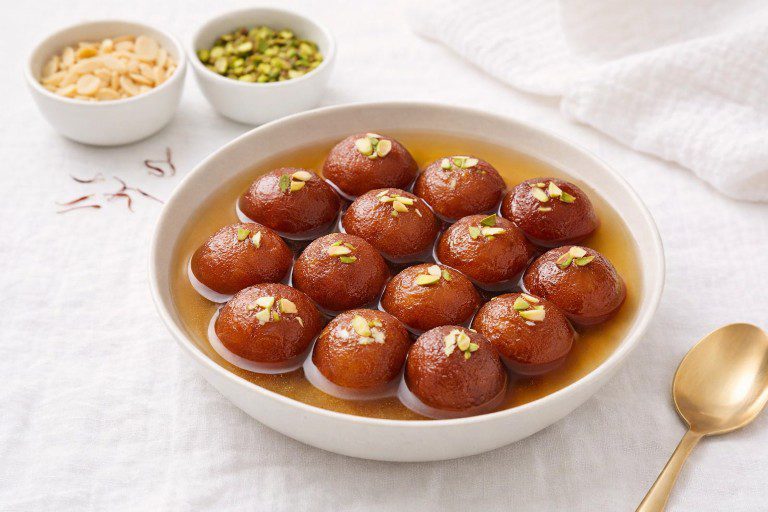
Traditional Gulab Jamun Recipe (Soft & Juicy Sweet)

March 27, 2025

Gulab jamun holds a special place in my heart because it is the one sweet that appeared at every celebration in our house growing up in Mumbai. Birthdays, Diwali, Eid at our neighbour's home, even random Sunday afternoons when my mother felt like making something sweet — gulab jamun was always the answer. The first time I tried making it myself, the balls cracked open in the oil because I had kneaded the dough too much. It took me a few attempts to learn that the dough needs a gentle, light touch and the oil has to be on a low flame. This recipe is the version I now trust completely, and every time I make it, the smell of the sugar syrup simmering with cardamom and rose water fills the kitchen in a way that feels like home.

Gulab jamun is one of India's most beloved desserts, and it has earned that place by showing up at every celebration that matters. Golden-brown, deep-fried sweet dumplings soaked in fragrant sugar syrup — the combination is simple, but the result carries centuries of history and tradition. It is the kind of sweet that brings families together across generations, and no festive table in India feels complete without it.

Origins and Evolution

Gulab Jamun traces its origins to the Persian and Turkish regions. Originally, a similar dessert known as Luqmat al-Qadi was widely enjoyed there. Subsequently, during the Mughal dynasty, Indian cuisine drew heavily on Persian culinary traditions. As a result, this dessert gradually evolved into what we now recognise as Gulab Jamun.

The name itself is derived from two Persian words: “Gulab” (rose water) and “Jamun” (a berry native to the Indian subcontinent that resembles the sweet in shape and colour). Thus, even its name reflects a blend of cultures.

According to popular belief, Gulab Jamun was accidentally discovered by the royal chefs of the Mughal emperor Shah Jahan while experimenting with Persian-style ingredients. Over time, it gained immense popularity across India. Eventually, it became a staple at weddings, religious ceremonies, royal banquets, and festive occasions.

Why Is Gulab Jamun So Popular?

There are several reasons behind its enduring popularity.

First and foremost, it is a festive favourite. Whether it is Diwali, Eid, Holi, or a grand wedding, Gulab Jamun is almost always present.
Secondly, it symbolises hospitality. Serving Gulab Jamun to guests immediately conveys warmth and generosity.
Moreover, it is highly versatile. Over the years, regional variations such as Kala Jamun, Pantua (from Bengal), and Dry Gulab Jamun have emerged. As a result, every region has added its own signature touch.

In short, Gulab Jamun is more than just a dessert — it is an emotion.

Now, let us move on to preparing this irresistible sweet at home.

Traditional Gulab Jamun Recipe

Preparation Time: 20 minutes
Cooking Time: 30 minutes
Soaking Time: 2–3 hours
Total Time: Approximately 3 hours 50 minutes

Ingredients for the Dough

  • 1 cup crumbled khoya (mawa)
  • 3 tbsp all-purpose flour (maida)
  • ¼ tsp baking soda
  • 2 tbsp milk (or as required)
  • ½ tsp cardamom powder
  • 1 tbsp ghee (for kneading)

For the Sugar Syrup:

  • 1½ cups sugar
  • 1½ cups water
  • ½ tsp cardamom powder
  • 1 tsp rose water
  • A few saffron strands (optional)
  • 1 tsp lemon juice (to prevent crystallisation)

For Frying:

  • Ghee or neutral oil (for deep frying)

Step-by-Step Guide

1: Prepare the Sugar Syrup

First, combine sugar and water in a pan. Heat on low flame and stir until the sugar dissolves completely.
Then, add saffron, rose water, cardamom powder, and lemon juice.
After that, allow the syrup to simmer gently for 5–7 minutes until slightly sticky but not thick.
Meanwhile, keep the syrup warm on the lowest heat while you prepare the dough balls.

2: Make the Dough

Next, grind the khoya in a large bowl until smooth and lump-free.
Then, add all-purpose flour, baking soda, and cardamom powder. Mix well.
Gradually, add milk and knead gently to form a soft, non-sticky dough. However, avoid over-kneading, as this may result in hard jamuns.
Afterwards, cover the dough and let it rest for 10 minutes.

3: Shape the Jamuns

Once rested, grease your palms with ghee.
Then, divide the dough into equal portions.
Carefully, roll them into smooth, crack-free balls about the size of a marble. Importantly, ensure there are no cracks, as cracks may cause them to break while frying.

4: Fry the Jamuns

Now, heat ghee or oil in a deep pan over low-medium heat. The oil should be lukewarm — not hot.
To test, drop a small piece of dough into the oil. If it rises slowly without browning too quickly, the temperature is correct.

Next, gently add the dough balls.
Meanwhile, stir continuously and fry on low heat for even browning.
Gradually, they will turn golden brown. This process usually takes 6–8 minutes per batch.
Finally, remove and drain excess oil on paper towels.

5: Soak in Sugar Syrup

Immediately after frying, transfer the warm jamuns into the prepared warm syrup.
Then, let them soak for at least 2–3 hours.
During this time, they will absorb the syrup and almost double in size.
Consequently, they become soft, juicy, and melt-in-the-mouth delicious.

6: Serve and Enjoy

Once fully soaked, serve warm or at room temperature.
Additionally, garnish with chopped almonds or pistachios for extra richness.
For a modern twist, pair with vanilla ice cream.

Nutrition Facts (Approx. 2 Pieces)

  • Calories: 180 kcal
  • Carbohydrates: 30g
  • Protein: 2g
  • Fat: 6g
  • Sugars: 20g

Tips for Perfect Gulab Jamun

To begin with, use fresh khoya for the best texture. Alternatively, milk powder and cream can be substituted.
Secondly, always fry on low heat. High heat may brown the outside quickly while leaving the inside uncooked.
Furthermore, ensure the syrup is warm — not boiling — when adding the jamuns. Otherwise, they may turn hard.
In addition, adding a pinch of saffron and a few drops of kewra enhances flavour.
Above all, make sure the dough is smooth and crack-free to avoid breaking during frying.

Conclusion

Gulab Jamun is far greater than the sum of its ingredients. Indeed, it represents celebration, heritage, and shared memories. From lavish wedding banquets to intimate family dinners, it consistently brings people together. Ultimately, its melt-in-the-mouth texture and aromatic sweetness make it timeless.

In conclusion, preparing Gulab Jamun at home not only satisfies your sweet cravings but also connects you to a rich culinary history.

Would you like a baked or instant version of this recipe? Let me know in the comments below!

Share your thoughts on Instagram @thefood.travellers


Like
Close
Copyright © 2022 LEMON & LIMES.
Made with by Loft.Ocean. All rights reserved.
Close