

Introduction
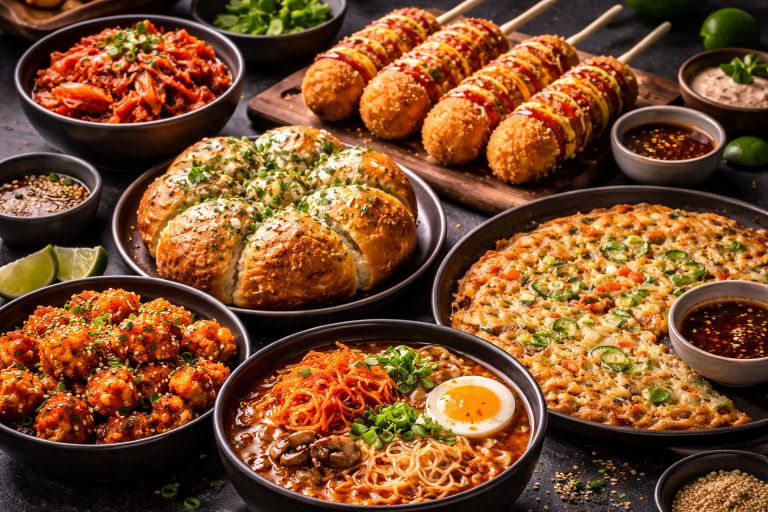
Vegetarian Korean Recipes have captured the imagination of food lovers worldwide. In fact, from the fermented depths of kimchi to the crispy drama of Korean corn dogs, from the bold heat of gochujang to the sweet-savory pull of cream cheese garlic bread — Korean food delivers one of the most exciting and distinctive flavor experiences on the planet.
Furthermore, Korean cuisine translates remarkably well to vegetarian cooking. Because Korean food derives its extraordinary depth from fermented ingredients — gochujang, doenjang, soy sauce, and kimchi — rather than meat, vegetarian Korean recipes achieve the same complexity and satisfaction as their non-vegetarian counterparts.
At The Food Travellers, we have documented our favorite vegetarian Korean recipes — bringing authentic Korean flavours into your home kitchen. Moreover, the global rise of K-drama, K-pop, and Korean street food culture has made this the perfect time to explore Korean cuisine at home.
Whether you are discovering Korean food for the first time or looking to expand your Korean cooking repertoire — this complete guide organizes every Korean recipe on the site in one place.
Table of Contents
- Why Korean Cuisine Is Perfect for Vegetarians
- Korean Fermented Foods
- Korean Street Food Recipes
- Korean Bakery Recipes
- Korean Soups and Stews
- Korean Side Dishes and Vegetables
- Essential Korean Ingredients Guide
- Frequently Asked Questions
Why Korean Cuisine Is Perfect for Vegetarians
Korean food culture has a rich vegetarian tradition rooted in Buddhist temple cooking — called 사찰음식 (sachal eumsik) — that developed over more than a thousand years of monastery cooking. Furthermore, Korean Buddhist temples developed some of the most sophisticated plant-based cooking techniques in the world, using fermentation, pickling, and slow cooking to extract extraordinary flavor from vegetables alone.
Because Korean cuisine relies so heavily on fermented condiments for flavor rather than meat-based stocks, vegetarian Korean recipes naturally achieves the same depth and complexity as meat-based dishes. As a result, ingredients like gochujang (fermented red chilli paste), doenjang (fermented soybean paste), and kimchi (fermented vegetables) do all the heavy flavor lifting that meat does in other cuisines.
Moreover, according to the Korea Tourism Organization, temple food (sachal eumsik) has become one of the most sought-after culinary experiences for international visitors to Korea — a testament to how extraordinary vegetarian Korean recipes can be.
The Five Flavors of Korean Cuisine
Korean culinary philosophy organizes food around five essential flavours — sweet, sour, salty, bitter, and spicy — and aims to balance all five in every meal. Furthermore, this philosophy extends to colour — traditional Korean meals aim to include five colours representing different nutritional groups. As a result, a well-prepared Korean meal delivers both exceptional flavour balance and outstanding nutritional completeness.
Korean Fermented Foods
Fermentation sits at the absolute heart of Korean cuisine. Specifically, Korea has developed one of the world’s most sophisticated fermentation traditions — producing kimchi, doenjang, gochujang, and ganjang (soy sauce) through processes refined over thousands of years. Furthermore, modern science has confirmed what Korean communities always knew — fermented foods deliver extraordinary health benefits through their probiotic content.
According to Healthline’s research on fermented foods, regular consumption of fermented vegetables and condiments supports gut health, immune function, and overall wellbeing.
History of Kimchi — Korea’s Most Famous Fermented Dish
Kimchi stands as Korea’s greatest culinary contribution to the world — a deeply complex fermented vegetable dish with a history stretching back over 2,000 years. Moreover, kimchi is not a single dish but a family of hundreds of variations — from the iconic napa cabbage kimchi to radish kimchi, cucumber kimchi, and seasonal varieties that change throughout the year.
Furthermore, the communal tradition of making kimchi — called Kimjang — was inscribed on UNESCO’s Intangible Cultural Heritage list in 2013, recognizing its profound cultural significance to Korean society. Because Kimjang brings families and communities together each autumn to prepare kimchi for the winter, it represents far more than a recipe — it embodies Korean values of community, sharing, and collective care.
🔗 History of Kimchi — Korea’s Famous Fermented Dish
Vegan Kimchi Ramen — A Delicious Plant-Based Bowl
Kimchi Ramen combines two of Korea’s most beloved foods — spicy fermented kimchi and warming ramen noodles — into a single deeply satisfying bowl. Moreover, this vegan version achieves remarkable depth of flavour through the fermented kimchi broth, making it one of the most satisfying plant-based noodle dishes you can make at home.
Furthermore, ramen in Korea has developed its own distinct identity from Japanese ramen — bolder, spicier, and more intensely flavoured thanks to the influence of gochujang and kimchi in the broth.
🔗 Vegan Kimchi Ramen Recipe — A Delicious Plant-Based Bowl
Street Food options in Vegetarian Korean recipes
Korean street food has become one of the fastest-growing global food trends — particularly among younger food lovers who discovered it through social media, K-drama food scenes, and the global spread of Korean restaurants. Furthermore, Korean street food perfectly balances bold flavours, creative textures, and theatrical presentation in ways that make it irresistible both to eat and to photograph.
Because Korean street vendors constantly innovate — combining traditional Korean flavours with global influences — the street food scene in Korea produces some of the most exciting new dishes in global cuisine each year.
Vegetarian Korean Corn Dogs — Crispy Korean Street Food
Korean corn dogs represent Korean street food innovation at its most playful and delicious — a cheese-filled stick coated in thick batter and creative toppings, deep-fried until golden and crispy. Moreover, this vegetarian version replaces the traditional sausage with stretchy mozzarella cheese, delivering all the drama and flavour of the original without any meat.
Furthermore, this post has become the most popular on The Food Travellers — with over 1,000 views — which speaks to the extraordinary global appetite for Korean street food content. Additionally, the unique potato coating and optional sugar dusting create a sweet-savory contrast that makes Korean corn dogs unlike any other street food in the world.
🔗 Vegetarian Korean Corn Dogs — Crispy Korean Street Food Recipe
Korean Bakery Recipes
Korean bakery culture has produced some of the most exciting and creative bread and pastry recipes in the world. Specifically, Korean bakers combine Western bread-making techniques with distinctly Korean flavour sensibilities — resulting in unique creations that have gone viral globally and spawned long queues outside bakeries across Seoul and beyond.
Furthermore, Korean bakery recipes translate beautifully to home cooking — requiring only basic baking equipment and readily available ingredients. As a result, these recipes deliver restaurant-quality results with minimal complexity.
Korean Cream Cheese Garlic Bread — Easy Korean Bakery Recipe
Korean Cream Cheese Garlic Bread has become one of the most viral food trends of recent years. A soft pull-apart bread roll filled with sweet cream cheese and coated in a buttery garlic sauce. Moreover, the combination of sweet cream cheese filling and savory garlic butter creates a flavor contrast. It instantly explains why this snack generates such extraordinary enthusiasm.
Furthermore, with 2,000 views and 10 likes, this post sits among the most popular on The Food Travellers — proving that Korean bakery recipes resonate strongly with the site’s audience. Because the recipe uses simple, widely available ingredients and requires no specialist equipment, it delivers impressive results for any home baker.
🔗 Korean Cream Cheese Garlic Bread — Easy Korean Bakery Recipe
Korean Soups and Stews
Korean cuisine has developed one of the world’s great soup and stew traditions. Specifically, soups and stews (guk, tang, and jjigae) form an essential part of every Korean meal — served alongside rice and banchan (side dishes) rather than as a separate course. Furthermore, Korean soups range from light and delicate to intensely bold and spicy, covering every flavor profile imaginable.
Because Korean soups rely on fermented condiments, dried vegetables, and umami-rich seaweeds for their base flavor rather than meat stocks, they adapt exceptionally well to vegetarian cooking.
Vegan Kimchi Ramen — Warming Korean Noodle Soup
Beyond its role as a fermented condiment, kimchi transforms into an extraordinary soup base when simmered — releasing its complex fermented flavours into the broth and creating a deeply warming, spicy noodle soup. Moreover, this recipe demonstrates how a single fermented ingredient can carry an entire dish’s flavor profile.
🔗 Vegan Kimchi Ramen Recipe — A Delicious Plant-Based Bowl
From Japan to the World — The Story of Ramen
Ramen occupies a fascinating position in Korean food culture — originating in Japan but developing a distinctly bold Korean identity through the influence of gochujang and kimchi. Furthermore, Korean ramyeon (instant ramen) has become one of the most culturally significant foods in Korea — appearing in countless K-drama scenes and representing comfort, simplicity, and late-night satisfaction.
Moreover, this post explores the extraordinary global journey of ramen — from its Chinese noodle origins through Japan’s post-war reinvention to Korea’s fiery adaptation and eventual worldwide domination.
🔗 From Japan to the World — The Story of Ramen
Vegetarian Korean Recipes Side Dishes and Vegetables
Banchan — the collection of small side dishes served alongside every Korean meal — represents one of Korean cuisine’s most distinctive and generous traditions. Specifically, a traditional Korean meal might include five to twelve small dishes of pickled vegetables, seasoned greens, tofu preparations, and fermented condiments alongside the main dish and rice.
Furthermore, banchan is predominantly vegetarian by nature — making Korean side dish cooking one of the richest vegetarian traditions in global cuisine.
Crispy Gochujang Cauliflower — Korean Roasted Recipe
Crispy Gochujang Cauliflower showcases how a single Korean condiment can transform a simple vegetable into something extraordinary. Specifically, gochujang — Korea’s fermented red chilli paste — coats roasted cauliflower with a complex glaze that delivers heat, sweetness, umami, and depth simultaneously.
Moreover, this dish has garnered 5 comments on The Food Travellers — reflecting how strongly Korean-inspired vegetable dishes resonate with readers. Furthermore, gochujang cauliflower has become one of the most popular Korean-inspired dishes in vegetarian cooking worldwide, appearing on restaurant menus from London to Mumbai.
🔗 Crispy Gochujang Cauliflower — Korean Roasted Recipe
Veg Fried Rice — Easy Restaurant Style
While fried rice exists across many Asian cuisines, the Korean version — bokkeum-bap — has its own distinctive character, often incorporating gochujang or kimchi for a spicier, more intensely flavored result. Moreover, this recipe delivers the satisfying wok-tossed texture and bold seasoning that defines great fried rice across all its Asian variations.
🔗 Veg Fried Rice Recipe — Easy Restaurant Style
Crispy Korean Vegetable Pancake — Yachaejeon
Yachaejeon is one of Korea’s most beloved comfort foods. A crispy savory pancake packed with fresh vegetables and cooked until perfectly golden on both sides. Furthermore, Korean pancakes (jeon) represent a whole family of dishes that appear at every Korean celebration, family gathering, and rainy-day meal.
Because Yachaejeon uses simple, widely available vegetables and a basic batter, it stands as one of the most accessible entry points into Korean home cooking. Moreover, the crispy exterior and tender vegetable-filled interior make it satisfying as both a snack and a main dish.
🔗 Crispy Korean Vegetable Pancake — Yachaejeon
Essential Ingredients for Vegetarian Korean Recipes Guide
Understanding a handful of key Korean ingredients unlocks the ability to cook the entire Korean recipe collection at home. Furthermore, most of these ingredients are now widely available in Indian supermarkets, specialty food stores, and online retailers.
Gochujang — Korean Fermented Red Chilli Paste
Gochujang is the most essential ingredient in Korean cooking — a thick, deeply flavored fermented paste made from red chillies, glutinous rice, and soybeans. Furthermore, it delivers heat, sweetness, and profound umami simultaneously, making it unlike any other chilli condiment in global cuisine. Because gochujang is fermented, it adds complexity that fresh chilli paste simply cannot achieve.
Doenjang — Korean Fermented Soybean Paste
Doenjang is Korea’s answer to Japanese miso — a deeply fermented soybean paste with bold, earthy flavour that forms the base of many Korean soups and sauces. Moreover, its intense umami makes it one of the most powerful flavour-building ingredients in vegetarian Korean recipes.
Kimchi — Korea’s Essential Fermented Vegetable
Kimchi functions simultaneously as a condiment, side dish, soup ingredient, and flavor base in Korean cooking. Furthermore, keeping a jar of good kimchi in the refrigerator opens up an enormous range of Korean recipes — from kimchi fried rice to kimchi jjigae to kimchi pancakes.
Sesame Oil — Korea’s Essential Finishing Oil
Korean sesame oil has a distinctly richer, more intensely roasted flavor than Chinese or Indian sesame oil. Moreover, a small drizzle added at the end of cooking transforms any Korean dish. It adds nutty depth and aroma that instantly signals authentic Korean flavor.
According to the Korean Food Promotion Institute, these four ingredients — gochujang, doenjang, kimchi, and sesame oil — form the flavor foundation of Korean cuisine and appear in some form in the majority of Korean recipes.
The Korean Food Wave — Why Vegetarian Korean Recipes are Everywhere
The K-Drama Effect
Korean dramas have introduced Korean food to billions of viewers worldwide. With iconic food scenes featuring ramyeon, chimaek (fried chicken and beer), and street food snacks. It is creating intense global curiosity about Korean cuisine. Furthermore, the global success of shows like Squid Game, Crash Landing on You, and My Love from the Star has driven dramatic increases in searches for Korean recipes worldwide.
Food and Health
Beyond its flavor appeal, Korean cuisine has gained recognition for its significant health benefits. Specifically, the fermented foods central to Korean cooking — kimchi, doenjang, and gochujang — deliver probiotic benefits that support gut health and immunity. Furthermore, the traditional Korean diet’s emphasis on vegetables, fermented foods, and moderate portions aligns strongly with modern nutritional science.
According to Harvard’s T.H. Chan School of Public Health, fermented foods and plant-based diets are among the most evidence-backed dietary patterns for long-term health.
Korean Food in India
Korean food has found a particularly receptive audience in India — because Indian palates already appreciate bold spices, complex fermented flavours, and the sweet-savoury-spicy combinations that define Korean cuisine. Moreover, the vegetarian adaptability of Korean food makes it especially well-suited to Indian cooking habits. As a result, Korean-inspired dishes have appeared on menus across Indian cities and in home kitchens nationwide.
Complete Korean Recipe Index
Korean Fermented Foods:
Korean Street Food:
Bakery items from Korea:
Korean Soups & Noodles:
Korean Vegetables & Side Dishes:
- 🔗 Crispy Gochujang Cauliflower — Korean Roasted Recipe
- 🔗 Veg Fried Rice Recipe — Easy Restaurant Style
Soups & Noodles from Korea:
Korean Vegetables & Side Dishes:
- 🔗 Crispy Gochujang Cauliflower
- 🔗 Veg Fried Rice Recipe
- 🔗 Crispy Korean Vegetable Pancake — Yachaejeon
Explore More Global Cuisine at The Food Travellers
Korean cuisine is just one chapter in our complete global food story. Furthermore, The Food Travellers documents vegetarian recipes from across the world. From Japanese miso soup to Italian pasta to Mediterranean salads.
Also explore our other recipe collections:
🔗 Complete Vegetarian Global Cuisine Guide — world recipes from Japan, Italy, Mediterranean and beyond
🔗 Complete Guide to Indian Regional Recipes — traditional dishes from every region of India
🔗 Complete Indian Street Food Guide — Mumbai classics, momos, chaat and
more
Follow our food journeys:
Frequently Asked Questions About Vegetarian Korean Recipes
Is Korean food vegetarian-friendly?
Yes — Korean cuisine has an extraordinarily rich vegetarian tradition rooted in Buddhist temple cooking. Furthermore, the fermented condiments that define Korean flavor — gochujang, doenjang, kimchi, and sesame oil — are all naturally plant-based. As a result, vegetarian Korean recipes delivers the same depth and complexity as meat-based dishes.
What is the most popular Korean recipe on The Food Travellers?
Vegetarian Korean recipes especially Corn Dogs is the most popular Korean recipe with over 1,000 views and 6 comments. Furthermore, Korean Cream Cheese Garlic Bread follows closely with 2,000 views and 10 likes. This makes Korean bakery and street food the most searched Korean content on the site.
What Korean ingredients should I buy first?
Start with gochujang and sesame oil — these two ingredients unlock the widest range of Korean recipes. Furthermore, both are now widely available in Indian supermarkets and online. Additionally, good quality kimchi — either homemade or store-bought — opens up another entire category of Korean dishes.
Are Vegetarian Korean recipes spicy?
Korean food can be spicy but does not have to be. Specifically, gochujang and kimchi both carry heat but the level is adjustable. Moreover, many Korean dishes — like cream cheese garlic bread and veg fried rice — contain no significant heat at all. Therefore, Korean cuisine accommodates all spice tolerance levels.
Can I make Korean food without specialist equipment?
Yes — all the Korean recipes on The Food Travellers require only standard kitchen equipment. Specifically, a deep pan for frying, a standard oven for baking. Also, a regular pot for soups cover everything you need. Furthermore, no specialist Korean cooking equipment is necessary for any recipe in this collection.
Where can I learn more about Korean food culture?
The Korean Food Promotion Institute and Korea Tourism Organization both offer comprehensive resources on Korean culinary traditions. You can also read about fermentation culture, and temple food. Furthermore, our History of Kimchi post provides a detailed exploration of Korea’s most important food tradition.
Follow our food journeys on Instagram @thefood.travellers and YouTube @TheFoodTravellers