

Introduction
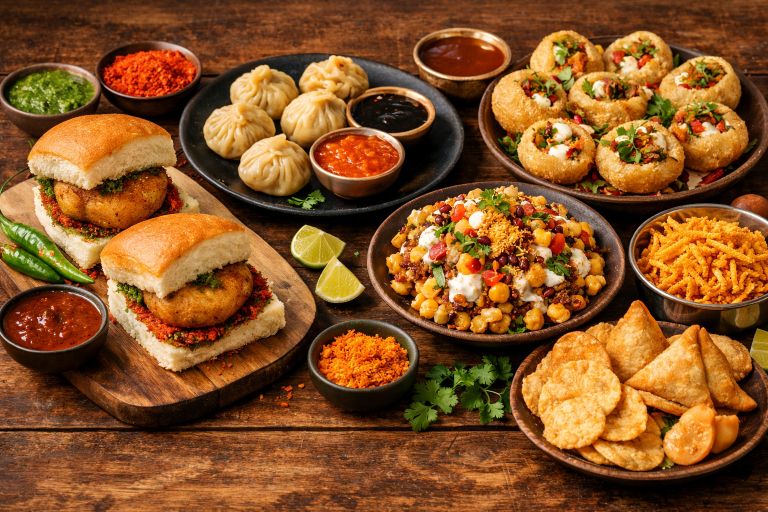
Indian street food ranks among the most exciting and diverse culinary traditions in the world. In fact, Every city and every street corner in India have its own signature snack. Local ingredients, regional flavours, and generations of vendors have shaped these dishes over decades. Local ingredients, regional flavours, and generations of street food vendors who perfected their craft over decades shaped each of these dishes into something extraordinary.
Furthermore, Indian street food delivers far more than just taste — it offers a complete sensory experience.
The sizzle of a tawa, the aroma of chaat masala, the crunch of fresh papdi — street food engages every sense. That tamarind chutney drizzling over a golden snack creates memories that linger long after the last bite.
At The Food Travellers, we document the most beloved Indian street food recipes. We test every recipe thoroughly and present each dish with full cultural context. Our goal goes beyond ingredients and steps — we tell the story behind every dish.
Crave Mumbai's vada pav? Delhi's raj kachori? Himalayan momos? This guide gives you everything you need. Bring authentic Indian street food into your kitchen today.
Table of Contents
- Mumbai Street Food Recipes
- Delhi & North Indian Street Food
- Himalayan Street Food
- Indo-Chinese Street Food
- Korean-Inspired Street Food
- Crispy Snacks & Starters
- Frequently Asked Questions
Mumbai Street Food Recipes
Mumbai holds the title of undisputed capital of Indian street food culture. Specifically, its streets have given India some of its most iconic snacks — dishes that travelled from Mumbai's busy footpaths to homes and restaurants across the entire country.
Mumbai draws millions of people from every part of India, and its street food reflects that extraordinary fusion of regional influences. Maharashtrian, Gujarati, South Indian, and even Chinese flavours all converge on Mumbai's streets, creating a food culture unlike anywhere else in the world.
Vada Pav — Mumbai's Iconic Street Burger
Vada Pav stands as arguably India's most beloved street food — a spiced potato fritter (vada) sitting inside a soft bread roll (pav) with layers of dry garlic chutney, green chutney, and fried green chillies. Moreover, Mumbaikars proudly call it the "Indian burger" — though any true Mumbaikar will insist it belongs in a category entirely its own.
Mumbai's mill workers first ate Vada Pav as an affordable, filling meal in the 1960s. As a result of its irresistible flavour and low cost, it grew into the definitive symbol of Mumbai street food culture. Today you find it everywhere — from humble street stalls to upmarket restaurant menus across India.
Vada Pav Recipe — Iconic Street Food of Maharashtra
Mumbai Style Pav Bhaji — Buttery Street Food Classic
Pav Bhaji delivers a thick, buttery vegetable mash alongside soft bread rolls that vendors toast in generous amounts of butter. Furthermore, it first appeared in Mumbai as a quick, nutritious meal for textile mill workers — street vendors combined leftover vegetables into a single spiced mash that they could prepare and serve rapidly to hungry crowds.
Today, Pav Bhaji attracts more searches than almost any other Indian street food recipe worldwide. Food lovers adore it for its bold flavour, satisfying texture, and the theatrical butter-laden cooking style that Mumbai's street vendors perform with such flair.
Mumbai Style Pav Bhaji Recipe — Buttery and Flavorful Street Food
Mumbai Style Sev Puri — Classic Street Food
Sev Puri is one of Mumbai's most celebrated chaat snacks — crispy puris topped with diced potatoes, onions, chutneys, and a generous shower of thin sev. Because every element contributes a different texture and flavour, Sev Puri delivers an extraordinary combination of crunch, tang, spice, and sweetness in every bite.
Mumbai Style Sev Puri Recipe — Classic Street Food
Mumbai Street-Style Chinese Pakoda — Crispy & Spicy
Mumbai's street food scene has absorbed Chinese influences so thoroughly that Indo-Chinese food is now considered a Mumbai street food tradition in its own right. For instance, Chinese Pakoda — crispy fried dumplings with a bold spiced coating — is a beloved Mumbai street snack that perfectly represents this fusion tradition.
Mumbai Street-Style Chinese Pakoda Recipe — Crispy & Spicy
Delhi & North Indian Street Food
Delhi's street food tradition is one of the oldest and most elaborate in India. Specifically, the city's chaat culture — built around crispy fried shells, tangy chutneys, spiced yogurt, and complex spice blends — represents centuries of culinary refinement.
Furthermore, North Indian street food is defined by its extraordinary use of chutneys — tamarind, mint, and date chutneys each playing a specific role in building the layered flavour profiles that make chaat so distinctive.
Raj Kachori — The King of Indian Chaat
Raj Kachori is the most elaborate and spectacular of all Indian street food dishes — a giant crispy shell filled with sprouts, potatoes, yogurt, multiple chutneys, pomegranate seeds, and sev. Because of its impressive size and complex assembly, food lovers rightly call it the "King of Chaat".
Moreover, making Raj Kachori at home is a genuine culinary project — but the result is so spectacular that it is absolutely worth the effort.
Raj Kachori Recipe — The King of Indian Chaat
Bhel Puri — Authentic Mumbai Street Style
Bhel Puri is one of India's most iconic street snacks — a light, tangy mixture of puffed rice, sev, chopped onions, tomatoes, boiled potatoes, and chutneys. Although it originated in Mumbai, Bhel Puri is now enjoyed across India with regional variations in every city.
Bhel Puri Recipe — Authentic Mumbai Street Style
Himalayan Street Food
The Himalayan foothills — spanning Sikkim, Darjeeling, Ladakh, and the northeastern states — have contributed some of India's most unique and beloved street food dishes. In particular, Indian restaurants now serve momos as one of their most ordered starters across India over the past decade.
Because Himalayan Street food developed at the crossroads of Indian, Tibetan, and Chinese culinary traditions, it offers flavour profiles found nowhere else in Indian cooking.
Veg Momos — 15 Café-Style Veg & Vegan Variations
Momos are steamed or fried dumplings that originated in Tibet and Nepal and arrived in India through the Himalayan border communities. Today, you find them at every corner of India — from Himalayan hill stations to Delhi street corners to Mumbai food courts — making them one of the fastest-growing street food trends in the country.
Furthermore, this comprehensive guide covers 15 different café-style variations — from classic steamed momos to pan-fried, tandoori, and soup momos. We compiled every variation in one place, making this the most complete momo resource on the site.
Veg Momos Recipe — 15 Café-Style Veg & Vegan Variations
Veg Momos — Street-Style with Spicy Chutney
This version focuses on the classic street-style momo preparation — simple, satisfying, and served with the fiery red chutney that defines the Himalayan street food experience.
Veg Momos Recipe — Street-Style with Spicy Chutney
Scallion Paneer Momos — Creamy Cottage Cheese Dumplings
A creative and delicious variation on the classic momo — combining creamy crumbled paneer with fresh scallions for a filling that is uniquely rich and aromatic. Moreover, these momos are served with a roasted garlic soy chilli sauce that elevates the entire dish to restaurant quality.
Scallion Paneer Momos Recipe — Easy & Delicious Dumplings
Indo-Chinese Street Food
Indo-Chinese cuisine is one of India's most beloved culinary inventions — a fusion tradition that emerged from the Chinese community in Kolkata and Mumbai and Delhi street food vendors subsequently reinvented it into something entirely unique.
Specifically, Indo-Chinese food uses Chinese techniques and sauces but applies them to Indian ingredients and spice levels — creating dishes that are bolder, spicier, and more intensely flavoured than their Chinese counterparts.
Crispy Chilli Chana — Spicy and Savory Snack
Crispy Chilli Chana is a popular Indo-Chinese street snack — crispy fried chickpeas tossed in a bold chilli-soy sauce with spring onions and peppers. Because chickpeas are naturally high in protein and fibre, this snack is as nutritious as it is delicious.
Crispy Chilli Chana Recipe — Spicy and Savory Snack
Korean-Inspired Street Food
Korean street food has become one of the fastest-growing food trends in India — particularly among younger food lovers who discovered Korean cuisine through K-dramas, K-pop culture, and social media food content.
Furthermore, Korean street food translates remarkably well to Indian palates because of its emphasis on bold flavours, crispy textures, and spicy-sweet-savoury combinations that resonate strongly with Indian food preferences.
Vegetarian Korean Corn Dogs — Crispy Korean Street Food
Korean corn dogs are one of the most visually dramatic and delicious street food snacks to emerge from Korean food culture — a cheese-filled stick coated in thick batter, diced potatoes or breadcrumbs, and deep-fried until golden. Moreover, this vegetarian version replaces the traditional sausage with stretchy mozzarella cheese, making it completely vegetarian without losing any of the excitement.
Additionally, this is currently the most popular post on The Food Travellers — with over 1,000 views and growing — which speaks to how much appetite there is for Korean-inspired street food content.
Vegetarian Korean Corn Dogs — Crispy Korean Street Food Recipe
Crispy Snacks & Starters
Beyond the iconic regional street food dishes, Indian street food culture has also produced a rich tradition of crispy fried snacks and starters that are perfect as appetizers, party snacks, or evening treats.
Honey Chilli Baby Corn — Sweet and Spicy Snack
Honey Chilli Baby Corn is a popular Indo-Chinese inspired snack — crispy fried baby corn tossed in a sticky honey-chilli sauce with spring onions and sesame seeds. Because of its sweet-spicy balance and satisfying crunch, diners order it more than almost any other starter at Indian restaurants.
Honey Chilli Baby Corn Recipe — Crispy Sweet and Spicy Snack
Crispy Corn — How to Make Crispy Corn at Home
Crispy Corn is one of India's most addictive snacks — sweet corn kernels coated in a light spiced batter and fried until perfectly crunchy. Furthermore, it is one of the easiest street food recipes to recreate at home with minimal equipment and ingredients.
Crispy Corn Recipe — How to Make Crispy Corn at Home
Grilled Cheese Sandwich — Crispy and Cheesy Delight
The Mumbai grilled cheese sandwich is a street food staple — layers of cheese, vegetables, and chutney between slices of bread, pressed and grilled until perfectly golden. Moreover, it represents the simple, satisfying end of the Indian street food spectrum — proof that great street food does not need to be complicated.
Grilled Cheese Sandwich Recipe — Crispy and Cheesy Delight
Why Indian Street Food Is So Beloved
Accessibility and Affordability
Indian street food has always belonged to the people. Specifically, working-class communities in India's cities drove its development as affordable, nutritious, and satisfying food. As a result, street food vendors perfected the art of delivering maximum flavour from simple, inexpensive ingredients — and that spirit of doing more with less defines the tradition to this day.
Bold and Complex Flavours
Indian street food separates itself from street food traditions worldwide through its extraordinary flavour complexity. A single plate of Raj Kachori combines six distinct flavours — tamarind, mint, yogurt, sev, potato, and pomegranate. No other street food culture matches this depth and complexity.
Cultural Identity
Indian street food is deeply connected to cultural identity. Moreover, every city takes enormous pride in its street food — Mumbai in its vada pav, Delhi in its chaat, Kolkata in its Kathi rolls, and the Himalayan cities in their momos. Therefore, eating Indian street food is never just about satisfying hunger — it is about participating in a living cultural tradition.
According to National Geographic's food culture documentation, street food traditions are among the most important expressions of urban cultural identity worldwide.
Tips for Making Indian Street Food at Home
Stock Up on Essential Chutneys
Most Indian street food recipes depend on two or three chutneys — tamarind chutney, green mint-coriander chutney, and sometimes a dry garlic chutney. Therefore, make a batch of each at the beginning of the week and assemble most chaat dishes in minutes.
Use Fresh Spice Blends
Chaat masala, pav bhaji masala, and sambar powder are the three most essential spice blends for Indian street food. Fresh spice blends beat packaged versions every time. Make your own or buy from a fresh spice shop.
Fry at the Right Temperature
Most fried Indian street food requires oil at 175-180°C for the crispiest results. Because oil that is too cool makes food greasy rather than crispy, investing in a kitchen thermometer is worthwhile if you make fried street food regularly.
Also explore our other recipe collections:
About The Food Travellers Street Food Collection
The street food collection at The Food Travellers celebrates the extraordinary diversity of Indian and global street food. Specifically, we test every recipe for vegetarian suitability and present it with full cultural context that goes beyond just ingredients and steps.
Furthermore, we continue to add new street food recipes regularly — so this guide grows with every new post published. Check back regularly or follow us on social media for the latest additions.
Follow our food journeys:
Frequently Asked Questions About Indian Street Food
What is the most popular Indian street food?
Vada Pav from Mumbai is widely considered India's most popular street food — affordable, filling, and deeply satisfying. However, momos have become the fastest-growing street food trend across India over the past decade, particularly among younger food lovers.
Is Indian street food vegetarian?
A large proportion of Indian street food is naturally vegetarian. In particular, Mumbai's chaat tradition, Delhi's chaat culture, and the Himalayan momo tradition all have extensive vegetarian offerings. Furthermore, every recipe in this collection is completely vegetarian.
How do I make Indian street food less oily?
The key to less oily fried street food is maintaining the correct oil temperature — 175-180°C. Low oil temperature causes greasy food. Use a thermometer and fry in small batches for crispy results.
Can I make Indian street food ahead of time?
Most Indian street food is best served fresh and immediately. However, chutneys, spice blends, and some fillings can be prepared ahead. For instance, momo fillings can be made a day in advance and refrigerated. Vada pav potato filling can be made several hours ahead. Therefore, preparation can be split across two sessions to make hosting easier.
What equipment do I need for Indian street food?
Indian street food needs just three tools — a deep pan, a tawa, and a steamer. Additionally, a kitchen thermometer is helpful for frying, and a high-powered blender makes chutney preparation much easier.
Explore More Street Food Recipes
- Vada Pav — Iconic Street Food of Maharashtra
- Mumbai Style Pav Bhaji
- Raj Kachori — The King of Indian Chaat
- Veg Momos — 15 Café-Style Variations
- Vegetarian Korean Corn Dogs
- Honey Chilli Baby Corn
- Crispy Corn Recipe
- Crispy Chilli Chana
- Mumbai Style Sev Puri
- Bhel Puri Recipe
- Grilled Cheese Sandwich
- Chinese Pakoda Recipe
- Scallion Paneer Momos